When discussing dimensions in various contexts, the measurement of 800 feet often comes into play, particularly in construction, landscaping, and outdoor planning. Understanding the implications of an 800-foot distance can be crucial for architects, engineers, and planners who require accurate spatial awareness for their projects. In the realm of construction, an 800-foot length can represent the span of a bridge, the length of a building, or the distance between significant points on a site. For instance, when designing a commercial property, the layout might extend 800 feet, influencing the flow of traffic and accessibility for both vehicles and pedestrians. Additionally, this length can impact zoning regulations, as certain codes may dictate how structures are spaced apart or how much land is utilized. In landscaping and outdoor design, 800 feet can serve as a guideline for creating functional and aesthetically pleasing spaces. For parks and recreational areas, an 800-foot walking path provides ample opportunities for jogging, cycling, or leisurely strolls, enhancing the overall user experience. When planning a sports field, such as a football or soccer field, 800 feet can serve as a benchmark for the dimensions and layout, ensuring that the space adheres to official regulations and standards. Moreover, in environmental planning, understanding the significance of an 800-foot radius can be essential for assessing the impact of developments on surrounding ecosystems. For instance, this distance can determine buffer zones around water bodies, helping to protect local wildlife and maintain ecological balance. In the context of real estate, properties that span 800 feet in width or length can offer unique features, allowing for expansive views and ample outdoor space for potential buyers. When marketing such properties, highlighting the generous dimensions can attract interest, emphasizing the possibilities for landscaping, gardening, or building extensions. Furthermore, in the field of aviation, an 800-foot runway may not be sufficient for larger aircraft, but it can be adequate for small general aviation planes. Understanding the limitations and capabilities of 800-foot runways is vital for airport planners and aviation authorities, ensuring safety and compliance with aviation standards. In various industries, the significance of 800 feet can also be seen in logistics and transportation. For example, warehouses or distribution centers often require precise measurements for the layout of loading docks and storage areas. An 800-foot long facility can optimize the flow of goods and streamline operations, contributing to efficiency in supply chain management. In summary, the measurement of 800 feet is a versatile dimension with various applications across multiple fields. From construction and landscaping to real estate and aviation, understanding the implications of this length is essential for effective planning and execution. Incorporating this knowledge into your projects can lead to improved designs, enhanced user experiences, and successful outcomes in your endeavors.
800 ft to m
800 Feet to Meters
800 Foot to Meter converter
The length of 800 feet, which converts to approximately 243.84 meters, is a measurement that holds significance across various fields such as construction, sports, aviation, and urban planning. Understanding this measurement can provide valuable context in both practical applications and theoretical discussions. In construction, 800 feet can represent the span of a large building, the length of a bridge, or the distance required for specific zoning regulations. For instance, in urban development, projects may be designed with consideration for pedestrian pathways or the distance between key landmarks, making 800 feet a relevant metric for planners and architects. In sports, a standard American football field measures 360 feet in length, which means that 800 feet is equivalent to more than two football fields laid end to end, providing a context for understanding distances in sporting events or the layout of athletic facilities. In aviation, runway lengths are crucial for takeoff and landing distances; while most commercial runways exceed 800 feet, understanding this length can help in discussing smaller airfields or private airstrips. Additionally, when discussing natural landscapes or geographic features, 800 feet can represent the height of cliffs, the length of hiking trails, or the span of rivers, enhancing the comprehension of outdoor activities and adventures. Overall, the measurement of 800 feet or 243.84 meters serves as a versatile unit that is applicable in numerous contexts, facilitating effective communication and planning in various industries. Whether you are involved in construction, sports, aviation, or environmental studies, recognizing and applying this measurement can enhance your understanding and decision-making processes.
How to convert 800 Feet to Meter?
| 800 ft * | 0.3048 m | = 243.84 m |
| 1 ft |
A common question is How many foot in 800 meter? And the answer is 2624.671916 ft in 800 m. Likewise the question how many meter in 800 foot has the answer of 243.84 m in 800 ft.
How much are 800 Feet in Meters?
800 Feet equal 243.84 Meters (800 ft = 243.84 m). Converting 800 ft to m is easy. Simply use our calculator above, or apply the formula to change the length 800 ft to m.
Convert 800 ft to common Lengths
| Unit | Length |
|---|---|
| Nanometer | 243840000000 nm |
| Micrometer | 243840000 µm |
| Millimeter | 243840 mm |
| Centimeter | 24384 cm |
| Inch | 9600 in |
| Yard | 266.666667 yd |
| Meter | 243.84 m |
| Kilometer | 0.24384 km |
| Mile | 0.151515 mi |
| Nautical Mile | 0.131663 nmi |
What is 800 Feet in m?
To convert 800 ft to m multiply the Lengths in by 0.3048. The 800 ft in m formula is [m] = 800 * 0.3048. Thus, for 800 Feet in Meter we get 243.84 m.
800 Foot Conversion Table
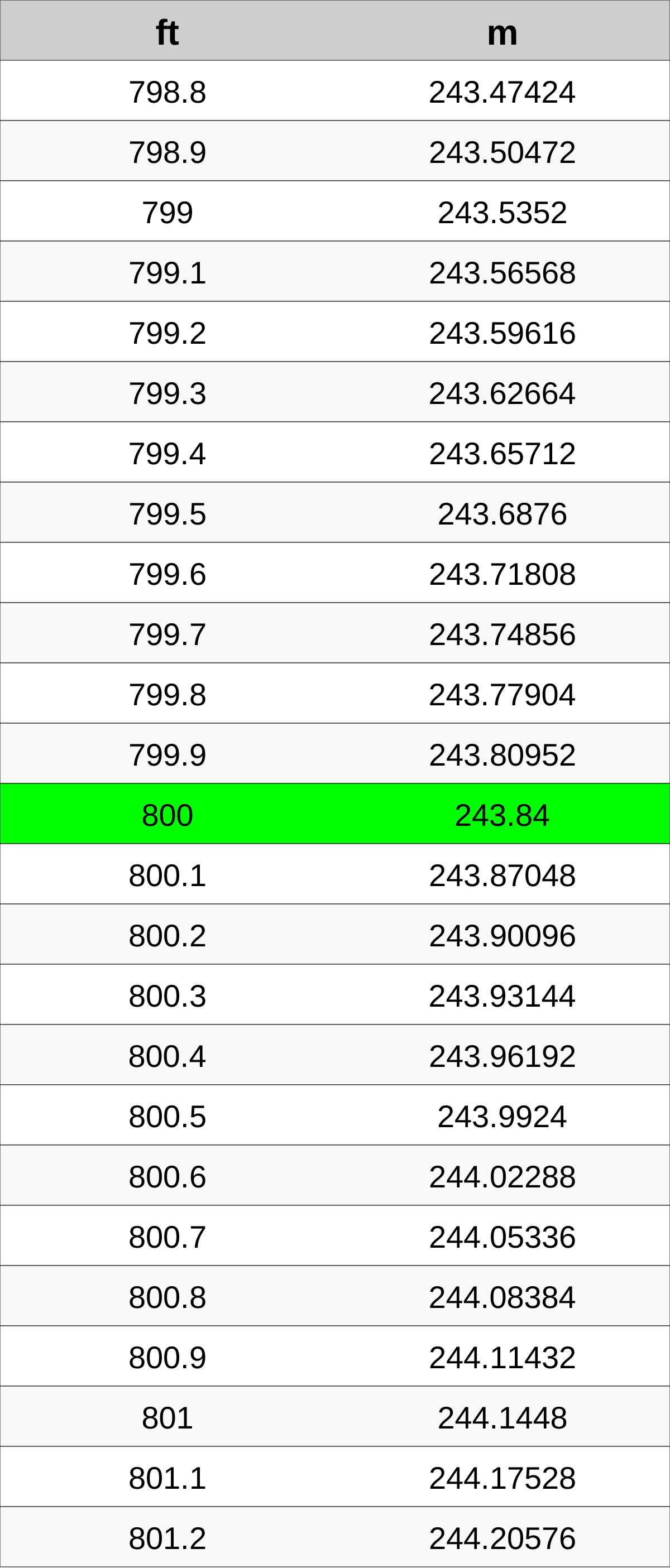
Further Foot to Meter calculations
- 790 Feet to Meters
- 791 Feet to Meters
- 792 Feet to Meter
- 793 ft to Meters
- 794 ft to Meter
- 795 Feet to Meters
- 796 Feet to m
- 797 Feet to Meters
- 798 ft to Meter
- 799 ft to Meter
- 800 ft to Meter
- 801 ft to Meters
- 802 Feet to m
- 803 ft to Meter
- 804 Feet to Meters
- 805 ft to Meters
- 806 ft to m
- 807 Feet to m
- 808 Feet to Meters
- 809 ft to Meter
- 810 Feet to m
Alternative spelling
800 ft to m, 800 ft into m, 800 ft in m, 800 Foot to Meter, 800 Foot into Meter, 800 Foot in Meter, 800 Feet to Meters, 800 Feet into Meters, 800 Feet in Meters, 800 Foot to m, 800 Foot into m, 800 Foot in m, 800 ft to Meter, 800 ft into Meter, 800 ft in Meter, 800 Feet to m, 800 Feet into m, 800 Feet in m, 800 ft to Meters, 800 ft into Meters, 800 ft in Meters
Further Languages
- 800 Feet To Meters
- 800 крак в Метър
- 800 Stopa Na Metr
- 800 Fod Til Meter
- 800 Fuß In Meter
- 800 πόδι σε μέτρο
- 800 Pie En Metro
- 800 Jalg Et Meeter
- 800 Jalka Metri
- 800 Pied En Mètre
- 800 Stopa U Metar
- 800 Láb Méter
- 800 Piede In Metro
- 800 Pėda Iki Metras
- 800 Piedi Fil Metr
- 800 Voet Naar Meter
- 800 Stopa Na Metr
- 800 Pé Em Metro
- 800 Picior în Metr
- 800 Stopa Na Meter
- 800 Fot Till Meter
- 800 Voet In Meter
- 800 متر إلى قدم
- 800 Ayaq Metr
- 800 ফুট মধ্যে মিটার
- 800 Peu A Metre
- 800 पैर से मीटर
- 800 Kaki Ke Meter
- 800 フィート・トゥ・メーターズ
- 800 발 미터
- 800 Fot Til Meter
- 800 нога в метр
- 800 Čevelj V Meter
- 800 Këmbë Në Metri
- 800 ฟุตเมตร
- 800 પગ મીટર
- 800 Fit Metre
- 800 нога в метр
- 800 Foot Sang Mét
- 800 英尺为米
- 800 英尺至米
- 800 Feet To Metree