When discussing measurements, the length of 1,370 feet is often encountered in various contexts, ranging from architectural designs to natural landmarks. This specific distance can be particularly significant in fields such as engineering, construction, and environmental studies. For example, in the realm of civil engineering, a structure measuring 1,370 feet could represent a high-rise building, a long bridge, or an expansive outdoor space. In terms of natural features, this length might describe the distance of a canyon, a river, or a unique geological formation. Understanding the practical implications of a length of 1,370 feet can aid in project planning and execution. For instance, when designing infrastructure, engineers must consider factors such as load distribution, materials, and environmental impact over such distances. Similarly, in landscaping projects, a span of 1,370 feet can influence the design of pathways, gardens, and recreational areas, providing ample space for both functionality and aesthetic appeal. In addition to its practical applications, the length of 1,370 feet can also be used for comparative analysis. For instance, it is equivalent to approximately 0.26 miles, which provides a relatable context for understanding distances. This can be useful in urban planning, where distances between amenities, parks, and residential areas are crucial for community design and accessibility. Overall, the significance of a length of 1,370 feet extends beyond mere measurement; it embodies a range of applications in various fields, highlighting the importance of precision and planning in both natural and constructed environments. Whether you are an architect, engineer, or simply curious about measurements, understanding the implications of this specific length can enhance your knowledge and inform your projects.
1370 ft to m
1370 Feet to Meters
1370 Foot to Meter converter
How to convert 1370 Feet to Meter?
| 1370 ft * | 0.3048 m | = 417.576 m |
| 1 ft |
A common question is How many foot in 1370 meter? And the answer is 4494.750656 ft in 1370 m. Likewise the question how many meter in 1370 foot has the answer of 417.576 m in 1370 ft.
How much are 1370 Feet in Meters?
1370 Feet equal 417.576 Meters (1370 ft = 417.576 m). Converting 1370 ft to m is easy. Simply use our calculator above, or apply the formula to change the length 1370 ft to m.
Convert 1370 ft to common Lengths
| Unit | Lengths |
|---|---|
| Nanometer | 417576000000 nm |
| Micrometer | 417576000 µm |
| Millimeter | 417576 mm |
| Centimeter | 41757.6 cm |
| Inch | 16440 in |
| Yard | 456.666667 yd |
| Meter | 417.576 m |
| Kilometer | 0.417576 km |
| Mile | 0.25947 mi |
| Nautical Mile | 0.225473 nmi |
What is 1370 Feet in m?
To convert 1370 ft to m multiply the Lengths in by 0.3048. The 1370 ft in m formula is [m] = 1370 * 0.3048. Thus, for 1370 Feet in Meter we get 417.576 m.
1370 Foot Conversion Table
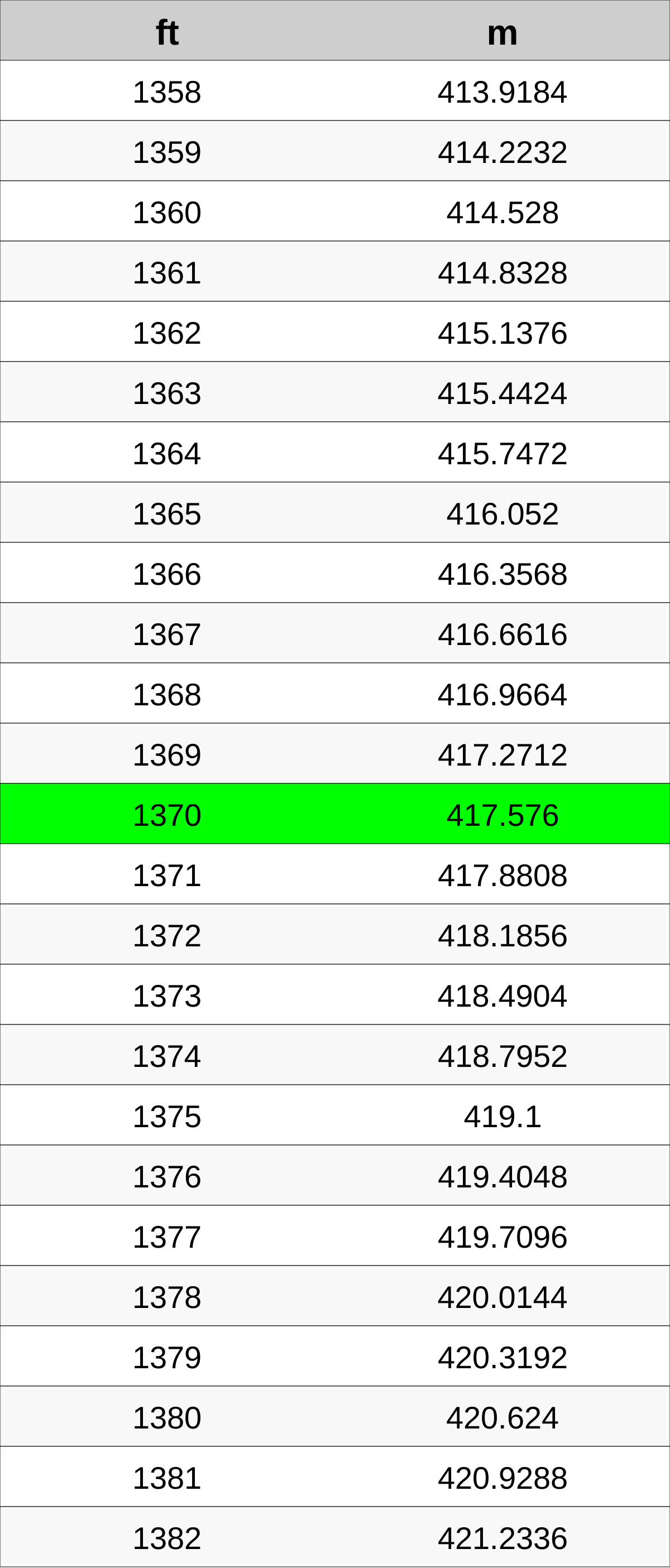
Further Foot to Meter calculations
- 1270 ft to Meter
- 1280 Feet to m
- 1290 ft to m
- 1300 Feet to m
- 1310 ft to m
- 1320 ft to Meters
- 1330 ft to Meter
- 1340 Feet to Meter
- 1350 Feet to m
- 1360 ft to Meters
- 1370 ft to Meter
- 1380 Feet to Meters
- 1390 Feet to Meters
- 1400 ft to Meters
- 1410 Feet to Meters
- 1420 ft to m
- 1430 Feet to Meter
- 1440 ft to m
- 1450 ft to m
- 1460 ft to Meter
- 1470 Feet to Meter
Alternative spelling
1370 ft to m, 1370 ft into m, 1370 ft in m, 1370 Foot to Meter, 1370 Foot into Meter, 1370 Foot in Meter, 1370 Feet to Meters, 1370 Feet into Meters, 1370 Feet in Meters, 1370 Foot to m, 1370 Foot into m, 1370 Foot in m, 1370 ft to Meter, 1370 ft into Meter, 1370 ft in Meter, 1370 Feet to m, 1370 Feet into m, 1370 Feet in m, 1370 ft to Meters, 1370 ft into Meters, 1370 ft in Meters
Further Languages
- 1370 Feet To Meters
- 1370 крак в Метър
- 1370 Stopa Na Metr
- 1370 Fod Til Meter
- 1370 Fuß In Meter
- 1370 πόδι σε μέτρο
- 1370 Pie En Metro
- 1370 Jalg Et Meeter
- 1370 Jalka Metri
- 1370 Pied En Mètre
- 1370 Stopa U Metar
- 1370 Láb Méter
- 1370 Piede In Metro
- 1370 Pėda Iki Metras
- 1370 Piedi Fil Metr
- 1370 Voet Naar Meter
- 1370 Stopa Na Metr
- 1370 Pé Em Metro
- 1370 Picior în Metr
- 1370 Stopa Na Meter
- 1370 Fot Till Meter
- 1370 Voet In Meter
- 1370 متر إلى قدم
- 1370 Ayaq Metr
- 1370 ফুট মধ্যে মিটার
- 1370 Peu A Metre
- 1370 पैर से मीटर
- 1370 Kaki Ke Meter
- 1370 フィート・トゥ・メーターズ
- 1370 발 미터
- 1370 Fot Til Meter
- 1370 нога в метр
- 1370 Čevelj V Meter
- 1370 Këmbë Në Metri
- 1370 ฟุตเมตร
- 1370 પગ મીટર
- 1370 Fit Metre
- 1370 нога в метр
- 1370 Foot Sang Mét
- 1370 英尺为米
- 1370 英尺至米
- 1370 Feet To Metree