The measurement of 1,360 feet is significant in various contexts, offering a perspective on both engineering and natural phenomena. In construction and architecture, understanding the implications of a length like 1,360 feet can be crucial for planning large structures, such as bridges, buildings, and tunnels. For instance, the dimensions of a sports stadium or a commercial complex often transcend this length, showcasing the scale at which modern engineering operates. In natural contexts, this measurement can relate to notable geographic features; for example, some mountain ranges or canyons may extend for 1,360 feet or more, highlighting the grandeur of nature. When discussing 1,360 feet in relation to athletics, it is an impressive distance that can be compared to various track and field events or even recreational activities like hiking. Understanding distances in feet can also aid in navigation and travel, particularly in urban settings where precise measurements are essential for mapping and logistics. In the realm of safety regulations and construction codes, knowing the significance of 1,360 feet can be vital. For example, this length might pertain to specific zoning laws, fire safety regulations, or even aviation safety standards concerning the clearance needed around buildings. For those involved in real estate or urban planning, the implications of a 1,360-foot length can inform decisions about land use, property dimensions, and infrastructure development. It can be a benchmark for evaluating the feasibility of projects and understanding community impact. In summary, the length of 1,360 feet is a versatile measurement that plays a critical role across various fields, including engineering, geography, athletics, safety regulations, and urban planning. Understanding this measurement can enhance comprehension and facilitate better decision-making in both professional and everyday contexts.
1360 ft to m
1360 Feet to Meters
1360 Foot to Meter converter
The measurement of 1360 feet, equivalent to 414.528 meters, is significant in various contexts, including architecture, engineering, and natural phenomena. Understanding this length can be essential for professionals in construction, urban planning, and even in the realm of sports. For instance, 1360 feet is approximately one quarter of a mile, making it a useful reference point for distance measurement in various applications. In architectural terms, this length can represent the height of skyscrapers or the span of large bridges, emphasizing the engineering feats necessary to achieve such dimensions. Additionally, this measurement is relevant in sports, such as in the context of baseball fields, where the distance from home plate to the outfield fence can be around this length. For those interested in environmental science, 1360 feet can also relate to the height of certain geological formations or the depth of marine trenches, thus providing context for discussions about Earth's topography. Moreover, understanding the conversion between feet and meters is crucial for international collaboration, especially in projects that require precise measurements across different systems of measurement. In summary, the length of 1360 feet, or 414.528 meters, serves as a versatile benchmark across various fields, highlighting its importance in both practical applications and theoretical discussions.
How to convert 1360 Feet to Meter?
| 1360 ft * | 0.3048 m | = 414.528 m |
| 1 ft |
A common question is How many foot in 1360 meter? And the answer is 4461.942257 ft in 1360 m. Likewise the question how many meter in 1360 foot has the answer of 414.528 m in 1360 ft.
How much are 1360 Feet in Meters?
1360 Feet equal 414.528 Meters (1360 ft = 414.528 m). Converting 1360 ft to m is easy. Simply use our calculator above, or apply the formula to change the length 1360 ft to m.
Convert 1360 ft to common Lengths
| Unit | Length |
|---|---|
| Nanometer | 414528000000 nm |
| Micrometer | 414528000 µm |
| Millimeter | 414528 mm |
| Centimeter | 41452.8 cm |
| Inch | 16320 in |
| Yard | 453.333333 yd |
| Meter | 414.528 m |
| Kilometer | 0.414528 km |
| Mile | 0.257576 mi |
| Nautical Mile | 0.223827 nmi |
What is 1360 Feet in m?
To convert 1360 ft to m multiply the Lengths in by 0.3048. The 1360 ft in m formula is [m] = 1360 * 0.3048. Thus, for 1360 Feet in Meter we get 414.528 m.
1360 Foot Conversion Table
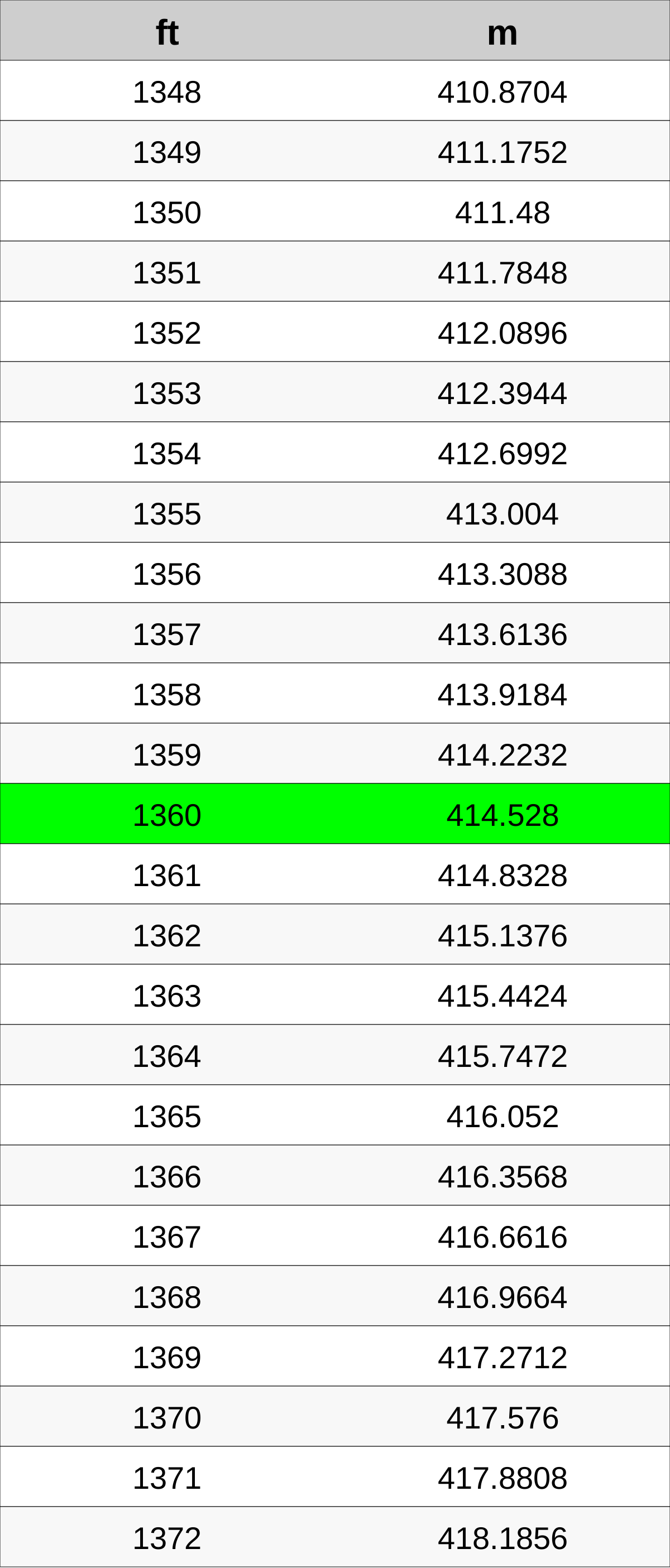
Further Foot to Meter calculations
- 1260 Feet to m
- 1270 Feet to Meters
- 1280 Feet to m
- 1290 ft to Meters
- 1300 ft to Meter
- 1310 ft to Meters
- 1320 Feet to Meter
- 1330 Feet to m
- 1340 Feet to Meters
- 1350 ft to Meters
- 1360 ft to Meter
- 1370 Feet to Meters
- 1380 Feet to m
- 1390 Feet to Meters
- 1400 ft to m
- 1410 Feet to Meter
- 1420 Feet to Meters
- 1430 ft to m
- 1440 ft to Meters
- 1450 Feet to m
- 1460 Feet to Meters
Alternative spelling
1360 ft to m, 1360 ft into m, 1360 ft in m, 1360 Foot to Meter, 1360 Foot into Meter, 1360 Foot in Meter, 1360 Feet to Meters, 1360 Feet into Meters, 1360 Feet in Meters, 1360 Foot to m, 1360 Foot into m, 1360 Foot in m, 1360 ft to Meter, 1360 ft into Meter, 1360 ft in Meter, 1360 Feet to m, 1360 Feet into m, 1360 Feet in m, 1360 ft to Meters, 1360 ft into Meters, 1360 ft in Meters
Further Languages
- 1360 Feet To Meters
- 1360 крак в Метър
- 1360 Stopa Na Metr
- 1360 Fod Til Meter
- 1360 Fuß In Meter
- 1360 πόδι σε μέτρο
- 1360 Pie En Metro
- 1360 Jalg Et Meeter
- 1360 Jalka Metri
- 1360 Pied En Mètre
- 1360 Stopa U Metar
- 1360 Láb Méter
- 1360 Piede In Metro
- 1360 Pėda Iki Metras
- 1360 Piedi Fil Metr
- 1360 Voet Naar Meter
- 1360 Stopa Na Metr
- 1360 Pé Em Metro
- 1360 Picior în Metr
- 1360 Stopa Na Meter
- 1360 Fot Till Meter
- 1360 Voet In Meter
- 1360 متر إلى قدم
- 1360 Ayaq Metr
- 1360 ফুট মধ্যে মিটার
- 1360 Peu A Metre
- 1360 पैर से मीटर
- 1360 Kaki Ke Meter
- 1360 フィート・トゥ・メーターズ
- 1360 발 미터
- 1360 Fot Til Meter
- 1360 нога в метр
- 1360 Čevelj V Meter
- 1360 Këmbë Në Metri
- 1360 ฟุตเมตร
- 1360 પગ મીટર
- 1360 Fit Metre
- 1360 нога в метр
- 1360 Foot Sang Mét
- 1360 英尺为米
- 1360 英尺至米
- 1360 Feet To Metree