The length of 840 feet is a significant measurement that can be applied in various contexts, including construction, sports, and even nature. Understanding how this length translates in different scenarios can enhance our comprehension of spatial dimensions. In construction, for instance, 840 feet is often seen in the specifications of large buildings, outdoor areas, or sporting complexes. For example, a standard football field, including the end zones, measures 360 feet in length, meaning that 840 feet is equivalent to about two and a third football fields. This comparison can help visualize the substantial distance and scale when planning projects or events. In sports, a track and field event may utilize a distance of 840 feet for specific races or relay events, showcasing the length's relevance in athletic contexts. Additionally, in environmental studies, the measurement of 840 feet may be critical when assessing the height of trees or the length of rivers and other natural features. Real estate professionals might also find the length of 840 feet valuable when discussing properties, such as land parcels or the dimensions of large estates. It can represent a substantial area, influencing zoning laws and development potential. In summary, the length of 840 feet serves as a versatile measure that finds application across various industries, including construction, sports, and real estate. Understanding this measurement can facilitate better planning, design, and appreciation of spatial relationships in both urban and natural environments. Whether you are involved in building projects, organizing sporting events, or evaluating land, recognizing the significance of 840 feet can enhance your decision-making process.
840 ft to m
840 Feet to Meters
840 Foot to Meter converter
The measurement of 840 feet, which is equivalent to 256.032 meters, is significant in various contexts, ranging from engineering and construction to sports and geography. Understanding the implications of this length can enhance clarity in communication, project planning, and design specifications. In architectural projects, for instance, 840 feet can define the span of a large building or the length of a bridge, influencing structural integrity and design aesthetics. In sports, this measurement can be relevant to the dimensions of athletic fields or tracks, where precise measurements are crucial for the regulation of play and safety of athletes. Additionally, in geographical terms, 840 feet can refer to elevation levels, such as the height of a hill or the depth of a valley, impacting ecological and environmental studies. The conversion of 840 feet to 256.032 meters underscores the importance of understanding both imperial and metric systems, especially in a globalized world where international collaboration is common. For instance, engineers and architects often need to convert measurements to ensure compatibility with local building codes and standards. Furthermore, incorporating the metric equivalent of 840 feet can enhance SEO strategies for websites targeting international audiences, as it caters to users who may prefer metric measurements over imperial ones. By leveraging this length in content, one can improve search engine visibility, making it easier for users to find relevant information about construction, sports, or geographical data. Ultimately, the length of 840 feet or 256.032 meters serves as a versatile and essential measurement across various industries, contributing to effective communication and understanding in both professional and academic settings.
How to convert 840 Feet to Meter?
| 840 ft * | 0.3048 m | = 256.032 m |
| 1 ft |
A common question is How many foot in 840 meter? And the answer is 2755.905512 ft in 840 m. Likewise the question how many meter in 840 foot has the answer of 256.032 m in 840 ft.
How much are 840 Feet in Meters?
840 Feet equal 256.032 Meters (840 ft = 256.032 m). Converting 840 ft to m is easy. Simply use our calculator above, or apply the formula to change the length 840 ft to m.
Convert 840 ft to common Lengths
| Unit | Length |
|---|---|
| Nanometer | 256032000000 nm |
| Micrometer | 256032000 µm |
| Millimeter | 256032 mm |
| Centimeter | 25603.2 cm |
| Inch | 10080 in |
| Yard | 280 yd |
| Meter | 256.032 m |
| Kilometer | 0.256032 km |
| Mile | 0.159091 mi |
| Nautical Mile | 0.138246 nmi |
What is 840 Feet in m?
To convert 840 ft to m multiply the Lengths in by 0.3048. The 840 ft in m formula is [m] = 840 * 0.3048. Thus, for 840 Feet in Meter we get 256.032 m.
840 Foot Conversion Table
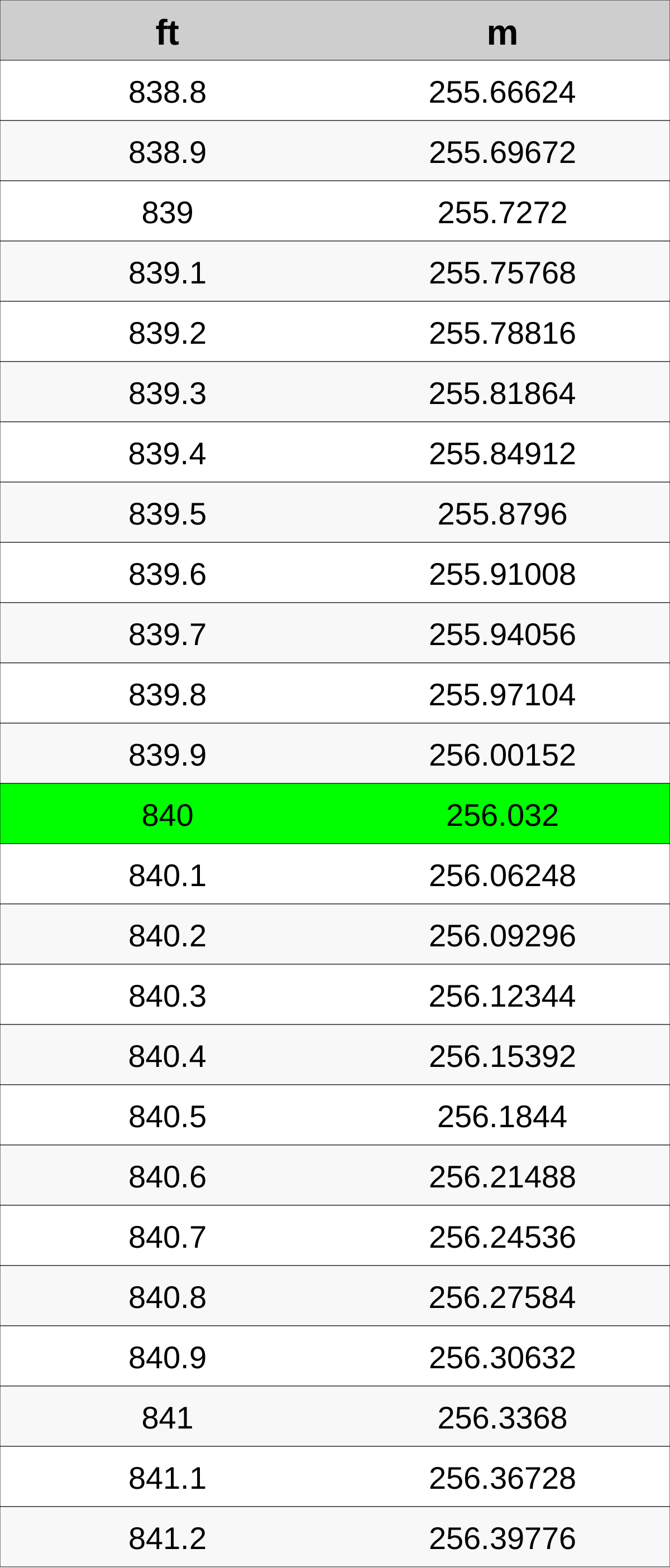
Further Foot to Meter calculations
- 830 Feet to Meter
- 831 ft to Meters
- 832 ft to Meter
- 833 Feet to Meter
- 834 ft to m
- 835 Feet to m
- 836 Feet to Meters
- 837 ft to Meters
- 838 ft to m
- 839 Feet to Meter
- 840 ft to m
- 841 Feet to m
- 842 ft to Meter
- 843 ft to m
- 844 Feet to Meters
- 845 Feet to Meter
- 846 Feet to m
- 847 ft to Meters
- 848 ft to Meters
- 849 ft to m
- 850 Feet to Meters
Alternative spelling
840 ft to m, 840 ft into m, 840 ft in m, 840 Foot to Meter, 840 Foot into Meter, 840 Foot in Meter, 840 Feet to Meters, 840 Feet into Meters, 840 Feet in Meters, 840 Foot to m, 840 Foot into m, 840 Foot in m, 840 ft to Meter, 840 ft into Meter, 840 ft in Meter, 840 Feet to m, 840 Feet into m, 840 Feet in m, 840 ft to Meters, 840 ft into Meters, 840 ft in Meters
Further Languages
- 840 Feet To Meters
- 840 крак в Метър
- 840 Stopa Na Metr
- 840 Fod Til Meter
- 840 Fuß In Meter
- 840 πόδι σε μέτρο
- 840 Pie En Metro
- 840 Jalg Et Meeter
- 840 Jalka Metri
- 840 Pied En Mètre
- 840 Stopa U Metar
- 840 Láb Méter
- 840 Piede In Metro
- 840 Pėda Iki Metras
- 840 Piedi Fil Metr
- 840 Voet Naar Meter
- 840 Stopa Na Metr
- 840 Pé Em Metro
- 840 Picior în Metr
- 840 Stopa Na Meter
- 840 Fot Till Meter
- 840 Voet In Meter
- 840 متر إلى قدم
- 840 Ayaq Metr
- 840 ফুট মধ্যে মিটার
- 840 Peu A Metre
- 840 पैर से मीटर
- 840 Kaki Ke Meter
- 840 フィート・トゥ・メーターズ
- 840 발 미터
- 840 Fot Til Meter
- 840 нога в метр
- 840 Čevelj V Meter
- 840 Këmbë Në Metri
- 840 ฟุตเมตร
- 840 પગ મીટર
- 840 Fit Metre
- 840 нога в метр
- 840 Foot Sang Mét
- 840 英尺为米
- 840 英尺至米
- 840 Feet To Metree