When discussing measurements, the term "2500 feet" can be significant in various contexts, including construction, aviation, sports, and geography. Understanding the implications of 2500 feet is crucial for professionals in these fields as well as for enthusiasts and researchers. In construction, a measurement of 2500 feet may relate to the length of a building, the size of a property, or the distance between two points on a construction site. For example, when planning a commercial development, architects and engineers must consider zoning regulations, which often specify minimum or maximum distances that structures must be set back from property lines or other buildings. A distance of 2500 feet can influence the layout of a project and the overall design. In aviation, 2500 feet is a critical altitude for pilots, particularly during takeoff and landing. Understanding the significance of this altitude is important for flight safety and air traffic control. For instance, when approaching an airport, aircraft often descend to 2500 feet as part of their final approach, allowing for safe navigation and landing procedures. Additionally, knowing the altitude can help in understanding airspace regulations, as certain airspaces may require different altitudes for safe operation. In sports, especially in track and field, a distance of 2500 feet can be converted to meters, approximately 762 meters, which is relevant for race lengths. Athletes training for long-distance events need to be aware of such conversions, as they often compete in various distances measured in both feet and meters. Furthermore, understanding race strategies for different lengths can help athletes optimize their performance and conditioning. Geographically, the significance of 2500 feet can refer to elevation, particularly in mountainous regions. For example, a location that is 2500 feet above sea level may have a different climate, vegetation, and wildlife compared to areas at sea level. This elevation can impact local ecosystems and is an important consideration for environmental studies, land use planning, and outdoor activities such as hiking and camping. In summary, the length of 2500 feet holds relevance across multiple disciplines, including construction, aviation, sports, and geography. Whether considering structural designs, flight operations, athletic competitions, or geographical features, the understanding and application of this measurement are essential for professionals and enthusiasts alike.
2500 ft to m
2500 Feet to Meters
2500 Foot to Meter converter
The measurement of 2500 feet, which is equivalent to approximately 762 meters, is a significant linear distance often referenced in various contexts, including aviation, construction, and outdoor activities. Understanding this distance is crucial for professionals in fields such as engineering, architecture, and environmental science, as well as for outdoor enthusiasts and sports enthusiasts. In aviation, 2500 feet is a typical altitude for certain flight maneuvers and is often utilized in approaches to landing. Pilots must be aware of this distance when considering airspace regulations, as it is also a common height for various air traffic control protocols. Additionally, understanding altitudes in both feet and meters is vital for international flights, where conversion between these two units is necessary for compliance with global aviation standards. In construction and urban planning, 2500 feet can represent significant distances when planning the layout of buildings, roads, and other infrastructure. For instance, a distance of 2500 feet could be the span between two major landmarks or the length of a new highway segment. Professionals in these fields often utilize this measurement to assess land use, zoning regulations, and the feasibility of projects. For outdoor enthusiasts, particularly hikers and campers, a distance of 2500 feet can be a pivotal factor in trail planning and navigation. Many trails in national parks and wilderness areas may vary in length, and a distance of 2500 feet can represent a moderate trek. This distance can influence the difficulty of a hike, as it typically requires a certain level of endurance and planning. Additionally, understanding elevation changes in relation to this distance can help hikers prepare adequately for altitude adjustments, especially in mountainous regions. In sports, particularly in track and field, distances are often measured in feet and meters, and a distance of 2500 feet can be relevant in events such as cross-country races or long-distance running. It is essential for athletes and coaches to understand how this distance correlates with race strategy, pacing, and endurance training. From a scientific perspective, measuring distances in both feet and meters is crucial in fields such as geology and environmental studies. For instance, understanding the distance of 2500 feet can be crucial in studying geological formations, soil types, and ecosystems. Scientists often need to convert these measurements to conduct research effectively, especially when collaborating internationally where metric measurements are standard. In summary, the distance of 2500 feet or 762 meters is a versatile measurement with implications across various fields. Whether in aviation, construction, outdoor activities, sports, or scientific research, understanding and accurately interpreting this distance is essential for effective communication, planning, and execution of projects and activities. As we continue to engage with the world around us, the significance of such measurements will remain integral in ensuring safety, efficiency, and success in numerous endeavors.
How to convert 2500 Feet to Meter?
| 2500 ft * | 0.3048 m | = 762 m |
| 1 ft |
A common question is How many foot in 2500 meter? And the answer is 8202.099738 ft in 2500 m. Likewise the question how many meter in 2500 foot has the answer of 762 m in 2500 ft.
How much are 2500 Feet in Meters?
2500 Feet equal 762 Meters (2500 ft = 762 m). Converting 2500 ft to m is easy. Simply use our calculator above, or apply the formula to change the length 2500 ft to m.
Convert 2500 ft to common Lengths
| Unit | Lengths |
|---|---|
| Nanometer | 762000000000 nm |
| Micrometer | 762000000 µm |
| Millimeter | 762000 mm |
| Centimeter | 76200 cm |
| Inch | 30000 in |
| Yard | 833.333333 yd |
| Meter | 762 m |
| Kilometer | 0.762 km |
| Mile | 0.473485 mi |
| Nautical Mile | 0.411447 nmi |
What is 2500 Feet in m?
To convert 2500 ft to m multiply the Lengths in by 0.3048. The 2500 ft in m formula is [m] = 2500 * 0.3048. Thus, for 2500 Feet in Meter we get 762 m.
2500 Foot Conversion Table
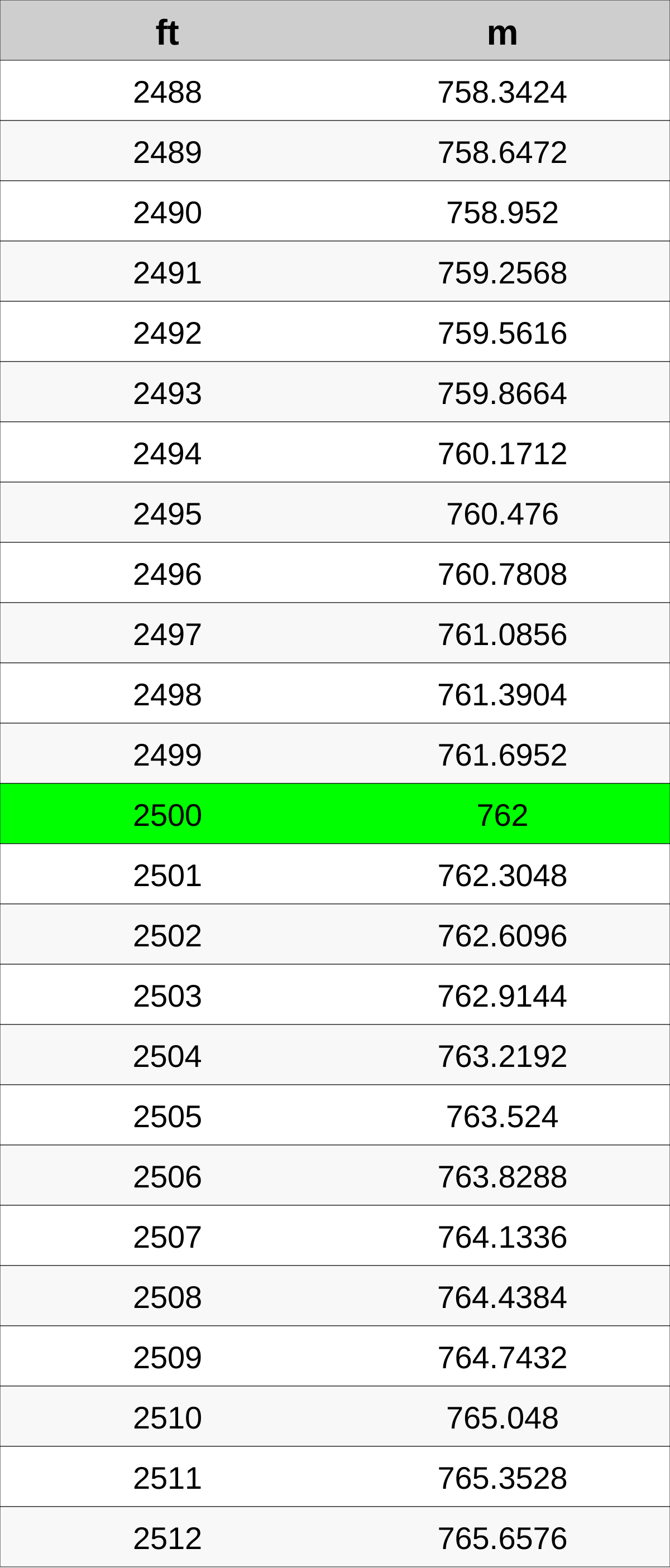
Further Foot to Meter calculations
- 2400 ft to Meter
- 2410 ft to Meter
- 2420 Feet to Meters
- 2430 Feet to Meters
- 2440 ft to Meters
- 2450 Feet to m
- 2460 ft to Meter
- 2470 Feet to m
- 2480 Feet to Meter
- 2490 ft to Meters
- 2500 ft to Meter
- 2510 ft to Meter
- 2520 ft to Meters
- 2530 Feet to m
- 2540 ft to Meter
- 2550 Feet to Meter
- 2560 Feet to m
- 2570 ft to Meters
- 2580 Feet to m
- 2590 Feet to Meters
- 2600 Feet to Meters
Alternative spelling
2500 ft to m, 2500 ft into m, 2500 ft in m, 2500 Foot to Meter, 2500 Foot into Meter, 2500 Foot in Meter, 2500 Feet to Meters, 2500 Feet into Meters, 2500 Feet in Meters, 2500 Foot to m, 2500 Foot into m, 2500 Foot in m, 2500 ft to Meter, 2500 ft into Meter, 2500 ft in Meter, 2500 Feet to m, 2500 Feet into m, 2500 Feet in m, 2500 ft to Meters, 2500 ft into Meters, 2500 ft in Meters
Further Languages
- 2500 Feet To Meters
- 2500 крак в Метър
- 2500 Stopa Na Metr
- 2500 Fod Til Meter
- 2500 Fuß In Meter
- 2500 πόδι σε μέτρο
- 2500 Pie En Metro
- 2500 Jalg Et Meeter
- 2500 Jalka Metri
- 2500 Pied En Mètre
- 2500 Stopa U Metar
- 2500 Láb Méter
- 2500 Piede In Metro
- 2500 Pėda Iki Metras
- 2500 Piedi Fil Metr
- 2500 Voet Naar Meter
- 2500 Stopa Na Metr
- 2500 Pé Em Metro
- 2500 Picior în Metr
- 2500 Stopa Na Meter
- 2500 Fot Till Meter
- 2500 Voet In Meter
- 2500 متر إلى قدم
- 2500 Ayaq Metr
- 2500 ফুট মধ্যে মিটার
- 2500 Peu A Metre
- 2500 पैर से मीटर
- 2500 Kaki Ke Meter
- 2500 フィート・トゥ・メーターズ
- 2500 발 미터
- 2500 Fot Til Meter
- 2500 нога в метр
- 2500 Čevelj V Meter
- 2500 Këmbë Në Metri
- 2500 ฟุตเมตร
- 2500 પગ મીટર
- 2500 Fit Metre
- 2500 нога в метр
- 2500 Foot Sang Mét
- 2500 英尺为米
- 2500 英尺至米
- 2500 Feet To Metree