The length of 1780 feet is a measurement that can be significant in various contexts, from engineering and construction to landscape design and sports. When discussing distances, particularly in the United States, feet are commonly used to convey measurements due to their practicality in everyday applications. Understanding the implications of a length of 1780 feet can aid in better planning and executing projects, whether large or small. In construction, 1780 feet could represent the length of a building or a specific section of a structure. For instance, in urban development, a site may be designed to accommodate a 1780-foot-long commercial complex. This length is substantial enough to house multiple businesses or amenities, creating a vibrant space for community interaction and economic growth. Additionally, knowing the length in feet can help architects and engineers calculate material needs, structural integrity, and compliance with safety regulations. In the realm of sports, a distance of 1780 feet can be relevant when discussing track and field events or even the dimensions of a sports field. For example, a standard American football field is 300 feet long, including the end zones, making 1780 feet equivalent to approximately six football fields in length. This distance might be used to set benchmarks for long-distance running events or to design a track that meets competitive standards. In landscape design, 1780 feet can define the length of a pathway, a garden, or a recreational area. Creating a walking trail or a bike path of this length can enhance community spaces, promoting outdoor activities and healthy lifestyles. Designers can utilize this measurement to ensure that pathways connect various points of interest, making them accessible and enjoyable for the public. In environmental studies, the significance of a length of 1780 feet can relate to ecological assessments, such as the distance along a riverbank or the width of a habitat corridor. Understanding distances like these is crucial for conservation efforts, as they help in planning for wildlife movement and habitat preservation. Overall, the length of 1780 feet serves as a versatile measurement that applies to numerous fields. Whether in construction, sports, landscape design, or environmental studies, acknowledging this distance can enhance planning, execution, and understanding of various projects. By taking into account the implications of a length of 1780 feet, professionals can make informed decisions that contribute to successful outcomes in their respective areas.
1780 ft to m
1780 Feet to Meters
1780 Foot to Meter converter
The length of 1780 feet, which is equivalent to approximately 542.544 meters, can serve various contexts across multiple fields, including engineering, architecture, sports, and geography. Understanding this measurement is essential for professionals and enthusiasts alike. In the realm of construction, knowing the dimensions in both feet and meters facilitates international collaboration and compliance with local regulations. For instance, a football field's length is about 360 feet or 109.73 meters, highlighting that 1780 feet is over four times the length of a standard field, making it substantial in size. In geographical terms, this length can also be visualized as the distance between significant landmarks, providing a relatable context for navigation and travel. In urban planning, a project spanning 1780 feet can influence zoning laws, public space design, and transportation infrastructure. For example, a pedestrian bridge or walkway of this length could enhance connectivity in a city, improving accessibility and promoting foot traffic. In sports, a track or field event that utilizes a distance close to 1780 feet can affect the design of athletic facilities, training programs, and competitive events. Furthermore, in scientific research, particularly in environmental studies, measuring distances such as 1780 feet can be crucial when surveying ecosystems or planning conservation efforts. It can also play a role in data collection and analysis when studying the effects of urban development on wildlife habitats. In summary, the length of 1780 feet or 542.544 meters is a significant measurement applicable in various fields. Its versatility underscores the importance of understanding and utilizing precise measurements for effective communication and planning in professional practices. This length can be integral to projects, studies, and designs that require careful consideration of distance and scale, ultimately impacting functionality and user experience.
How to convert 1780 Feet to Meter?
| 1780 ft * | 0.3048 m | = 542.544 m |
| 1 ft |
A common question is How many foot in 1780 meter? And the answer is 5839.895013 ft in 1780 m. Likewise the question how many meter in 1780 foot has the answer of 542.544 m in 1780 ft.
How much are 1780 Feet in Meters?
1780 Feet equal 542.544 Meters (1780 ft = 542.544 m). Converting 1780 ft to m is easy. Simply use our calculator above, or apply the formula to change the length 1780 ft to m.
Convert 1780 ft to common Lengths
| Unit | Lengths |
|---|---|
| Nanometer | 542544000000 nm |
| Micrometer | 542544000 µm |
| Millimeter | 542544 mm |
| Centimeter | 54254.4 cm |
| Inch | 21360 in |
| Yard | 593.333333 yd |
| Meter | 542.544 m |
| Kilometer | 0.542544 km |
| Mile | 0.337121 mi |
| Nautical Mile | 0.29295 nmi |
What is 1780 Feet in m?
To convert 1780 ft to m multiply the Lengths in by 0.3048. The 1780 ft in m formula is [m] = 1780 * 0.3048. Thus, for 1780 Feet in Meter we get 542.544 m.
1780 Foot Conversion Table
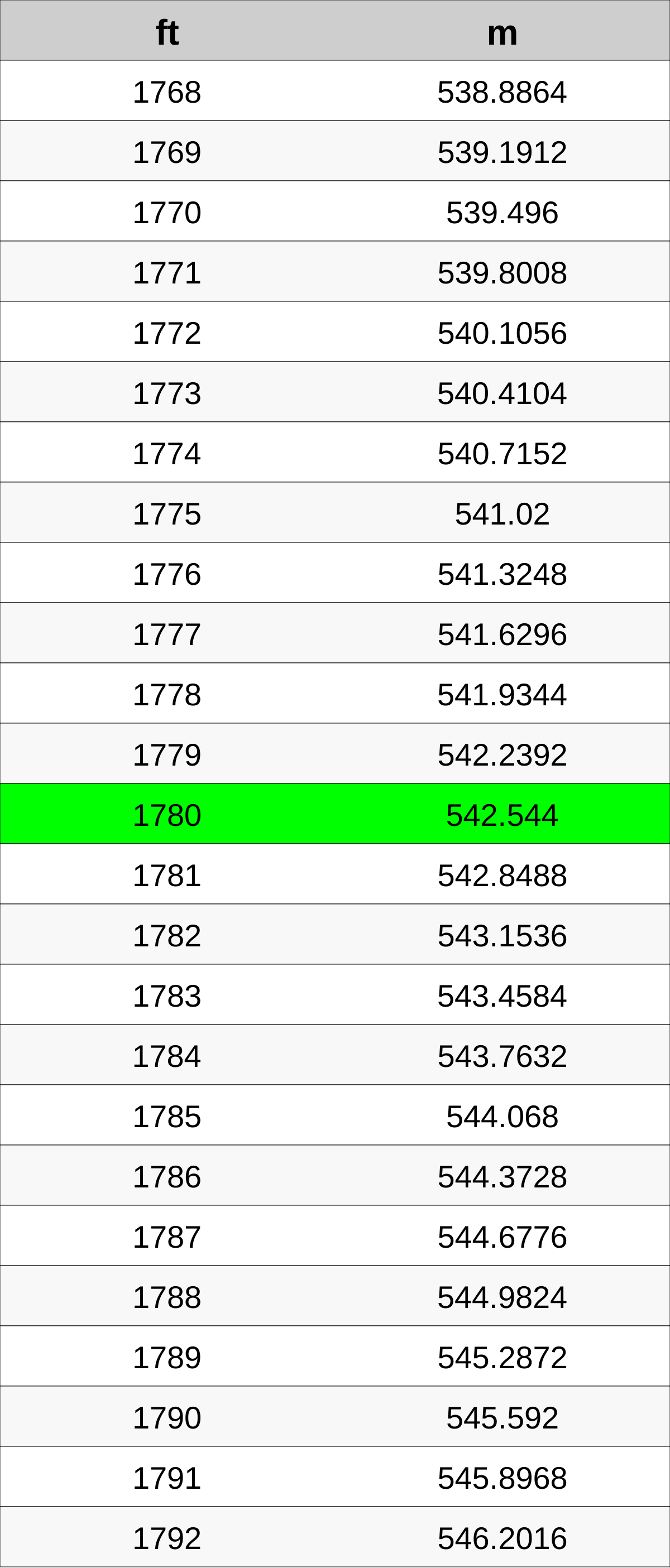
Further Foot to Meter calculations
- 1680 Feet to Meters
- 1690 Feet to Meters
- 1700 Feet to m
- 1710 Feet to m
- 1720 Feet to Meters
- 1730 Feet to Meter
- 1740 Feet to Meter
- 1750 Feet to m
- 1760 ft to Meter
- 1770 Feet to m
- 1780 Feet to m
- 1790 ft to Meter
- 1800 Feet to Meter
- 1810 ft to Meter
- 1820 ft to Meters
- 1830 Feet to Meter
- 1840 Feet to Meters
- 1850 ft to Meters
- 1860 ft to Meters
- 1870 ft to Meter
- 1880 ft to m
Alternative spelling
1780 ft to m, 1780 ft into m, 1780 ft in m, 1780 Foot to Meter, 1780 Foot into Meter, 1780 Foot in Meter, 1780 Feet to Meters, 1780 Feet into Meters, 1780 Feet in Meters, 1780 Foot to m, 1780 Foot into m, 1780 Foot in m, 1780 ft to Meter, 1780 ft into Meter, 1780 ft in Meter, 1780 Feet to m, 1780 Feet into m, 1780 Feet in m, 1780 ft to Meters, 1780 ft into Meters, 1780 ft in Meters
Further Languages
- 1780 Feet To Meters
- 1780 крак в Метър
- 1780 Stopa Na Metr
- 1780 Fod Til Meter
- 1780 Fuß In Meter
- 1780 πόδι σε μέτρο
- 1780 Pie En Metro
- 1780 Jalg Et Meeter
- 1780 Jalka Metri
- 1780 Pied En Mètre
- 1780 Stopa U Metar
- 1780 Láb Méter
- 1780 Piede In Metro
- 1780 Pėda Iki Metras
- 1780 Piedi Fil Metr
- 1780 Voet Naar Meter
- 1780 Stopa Na Metr
- 1780 Pé Em Metro
- 1780 Picior în Metr
- 1780 Stopa Na Meter
- 1780 Fot Till Meter
- 1780 Voet In Meter
- 1780 متر إلى قدم
- 1780 Ayaq Metr
- 1780 ফুট মধ্যে মিটার
- 1780 Peu A Metre
- 1780 पैर से मीटर
- 1780 Kaki Ke Meter
- 1780 フィート・トゥ・メーターズ
- 1780 발 미터
- 1780 Fot Til Meter
- 1780 нога в метр
- 1780 Čevelj V Meter
- 1780 Këmbë Në Metri
- 1780 ฟุตเมตร
- 1780 પગ મીટર
- 1780 Fit Metre
- 1780 нога в метр
- 1780 Foot Sang Mét
- 1780 英尺为米
- 1780 英尺至米
- 1780 Feet To Metree