The length of 1050 feet holds significant importance across various contexts, including construction, sports, aviation, and environmental studies. In construction, a structure measuring 1050 feet can represent a tall building, a long bridge, or an expansive outdoor space. This length is often used to illustrate the scale of large projects, helping stakeholders visualize the enormity of their endeavors. In sports, a 1050-foot distance might be relevant in scenarios such as baseball, where it can represent a home run distance, or in athletics, where it can relate to track and field events. In aviation, runway lengths are crucial for determining aircraft performance and safety; a runway of 1050 feet may be suitable for certain smaller aircraft, particularly in regional airports or private airstrips. Environmental studies also utilize the concept of distance, as a 1050-foot radius can be significant when assessing land usage or the impact of construction projects on surrounding ecosystems. Understanding the implications of a length of 1050 feet can enhance planning and decision-making in these diverse fields, making it a relevant measurement in various professional discussions.
1050 ft to m
1050 Feet to Meters
1050 Foot to Meter converter
The length of 1050 feet, which converts to approximately 320.04 meters, is a measurement that can be applied in various contexts, including construction, sports, transportation, and environmental studies. In terms of construction, a length of 1050 feet is significant when considering the dimensions of large buildings, bridges, or roads. For instance, many commercial buildings may span this length, creating expansive floor plans that can accommodate various business needs. In the realm of sports, a distance of 1050 feet is relevant in the context of track and field events, where athletes might sprint this distance in timed races or during training sessions. Additionally, this measurement is often used in the context of air travel; for example, runways can vary in length, and a runway measuring 1050 feet would be on the shorter side, suitable for smaller aircraft or specific types of operations. In environmental studies, understanding distances such as 1050 feet is crucial for assessing land use, zoning regulations, or environmental impacts. For instance, certain regulations may dictate buffer zones around water bodies, where development must be set back a specific distance measured in feet or meters. When it comes to surveying land, a length of 1050 feet can be a crucial reference point for plotting boundaries or designing infrastructure. In everyday life, this length can be visualized in various ways; for instance, it is approximately the length of three and a half football fields, providing a tangible reference for individuals unfamiliar with metric conversions. In urban planning, a distance of 1050 feet can also relate to pedestrian access, public transportation routes, and the overall layout of a community. It plays a role in determining how far people need to walk to access amenities, such as parks, schools, or shopping centers, thus influencing the design of walkable neighborhoods. Furthermore, in the context of real estate, properties may be described by their dimensions, and a length of 1050 feet can indicate the scale and potential use of a parcel of land. When considering safety regulations, particularly in construction and transportation, a length of 1050 feet may be relevant in assessing clearance heights, safety zones, or visibility requirements for drivers and pedestrians. This measurement can also be significant in aviation, where aircraft need sufficient space for takeoff and landing, and a runway of this length could represent limitations on the types of aircraft that can operate at a given airport. In summary, the length of 1050 feet, or approximately 320.04 meters, is a versatile measurement with applications across various fields, from construction and sports to environmental planning and real estate. Understanding this distance provides valuable context for professionals working in these areas, helping them make informed decisions based on spatial considerations.
How to convert 1050 Feet to Meter?
| 1050 ft * | 0.3048 m | = 320.04 m |
| 1 ft |
A common question is How many foot in 1050 meter? And the answer is 3444.88189 ft in 1050 m. Likewise the question how many meter in 1050 foot has the answer of 320.04 m in 1050 ft.
How much are 1050 Feet in Meters?
1050 Feet equal 320.04 Meters (1050 ft = 320.04 m). Converting 1050 ft to m is easy. Simply use our calculator above, or apply the formula to change the length 1050 ft to m.
Convert 1050 ft to common Lengths
| Unit | Lengths |
|---|---|
| Nanometer | 320040000000 nm |
| Micrometer | 320040000 µm |
| Millimeter | 320040 mm |
| Centimeter | 32004 cm |
| Inch | 12600 in |
| Yard | 350 yd |
| Meter | 320.04 m |
| Kilometer | 0.32004 km |
| Mile | 0.198864 mi |
| Nautical Mile | 0.172808 nmi |
What is 1050 Feet in m?
To convert 1050 ft to m multiply the Lengths in by 0.3048. The 1050 ft in m formula is [m] = 1050 * 0.3048. Thus, for 1050 Feet in Meter we get 320.04 m.
1050 Foot Conversion Table
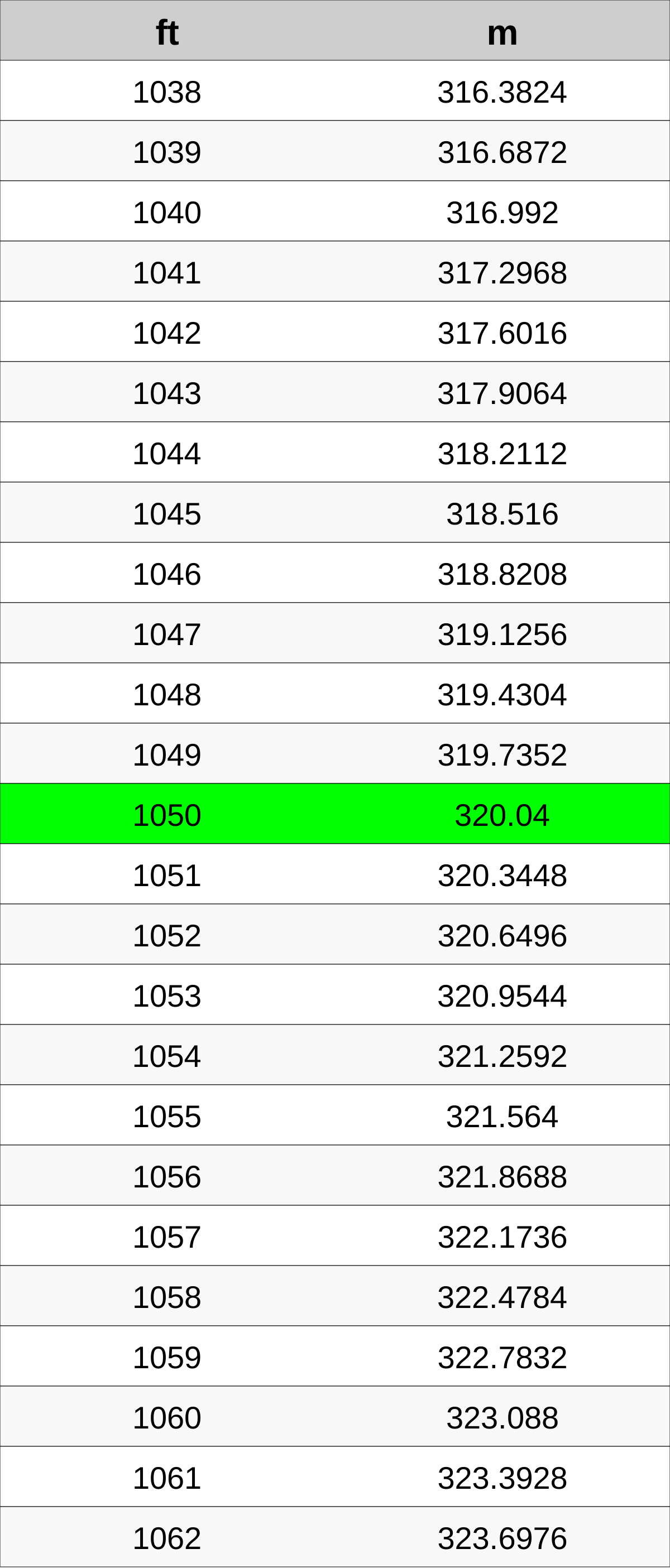
Further Foot to Meter calculations
- 995 ft to Meters
- 996 ft to Meters
- 997 ft to m
- 998 Feet to Meter
- 999 Feet to Meters
- 1000 Feet to Meter
- 1010 Feet to Meter
- 1020 ft to m
- 1030 ft to Meter
- 1040 Feet to m
- 1050 Feet to Meters
- 1060 Feet to m
- 1070 ft to m
- 1080 Feet to Meter
- 1090 Feet to m
- 1100 ft to Meters
- 1110 Feet to Meter
- 1120 ft to m
- 1130 ft to Meter
- 1140 Feet to Meter
- 1150 Feet to Meters
Alternative spelling
1050 ft to m, 1050 ft into m, 1050 ft in m, 1050 Foot to Meter, 1050 Foot into Meter, 1050 Foot in Meter, 1050 Feet to Meters, 1050 Feet into Meters, 1050 Feet in Meters, 1050 Foot to m, 1050 Foot into m, 1050 Foot in m, 1050 ft to Meter, 1050 ft into Meter, 1050 ft in Meter, 1050 Feet to m, 1050 Feet into m, 1050 Feet in m, 1050 ft to Meters, 1050 ft into Meters, 1050 ft in Meters
Further Languages
- 1050 Feet To Meters
- 1050 крак в Метър
- 1050 Stopa Na Metr
- 1050 Fod Til Meter
- 1050 Fuß In Meter
- 1050 πόδι σε μέτρο
- 1050 Pie En Metro
- 1050 Jalg Et Meeter
- 1050 Jalka Metri
- 1050 Pied En Mètre
- 1050 Stopa U Metar
- 1050 Láb Méter
- 1050 Piede In Metro
- 1050 Pėda Iki Metras
- 1050 Piedi Fil Metr
- 1050 Voet Naar Meter
- 1050 Stopa Na Metr
- 1050 Pé Em Metro
- 1050 Picior în Metr
- 1050 Stopa Na Meter
- 1050 Fot Till Meter
- 1050 Voet In Meter
- 1050 متر إلى قدم
- 1050 Ayaq Metr
- 1050 ফুট মধ্যে মিটার
- 1050 Peu A Metre
- 1050 पैर से मीटर
- 1050 Kaki Ke Meter
- 1050 フィート・トゥ・メーターズ
- 1050 발 미터
- 1050 Fot Til Meter
- 1050 нога в метр
- 1050 Čevelj V Meter
- 1050 Këmbë Në Metri
- 1050 ฟุตเมตร
- 1050 પગ મીટર
- 1050 Fit Metre
- 1050 нога в метр
- 1050 Foot Sang Mét
- 1050 英尺为米
- 1050 英尺至米
- 1050 Feet To Metree